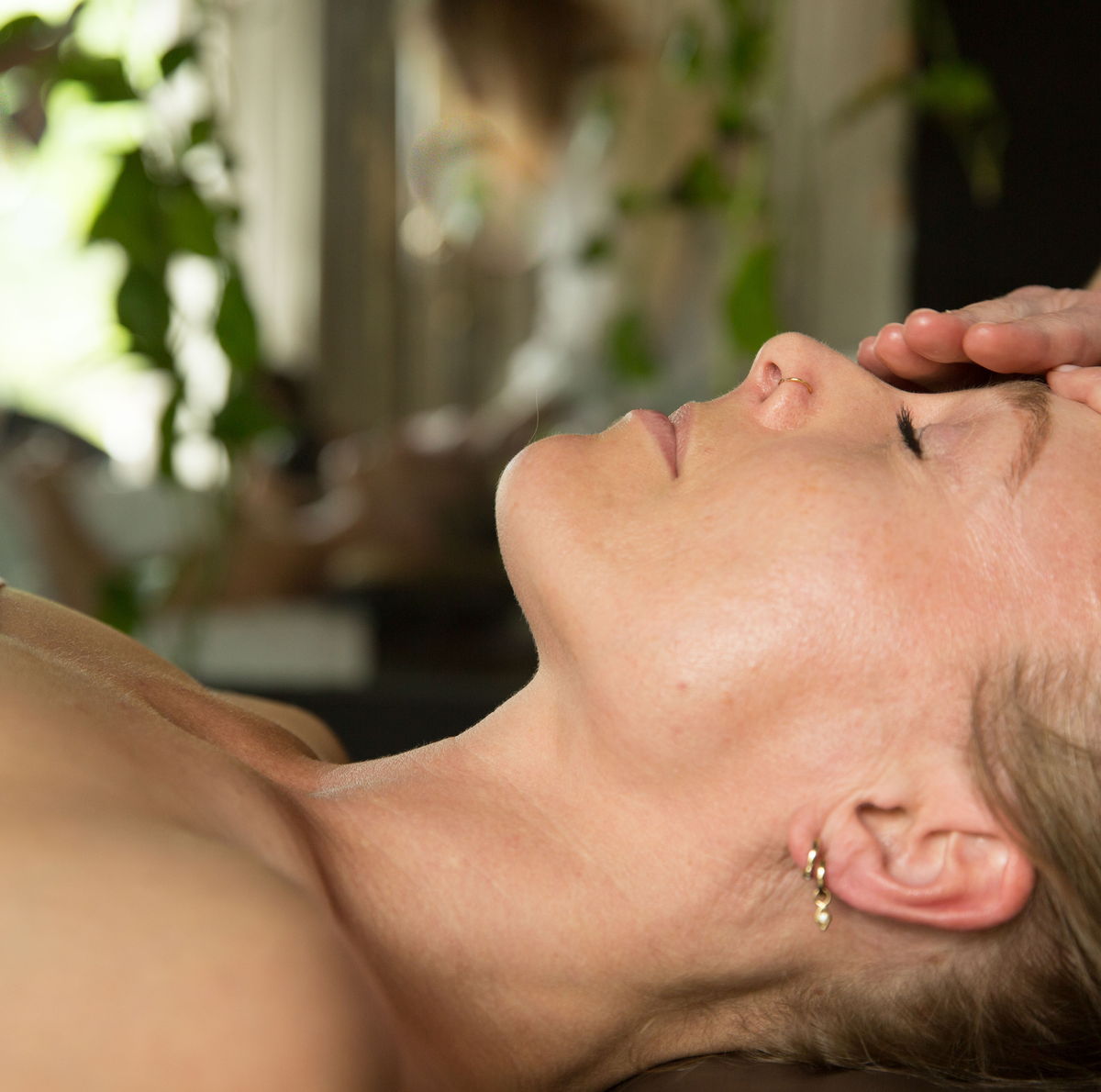
The question Tracy is asked most often is simply: what actually happens, and how is it different?
Below is roughly what she explains in a first consultation. If you'd rather talk it through before committing to anything, you're welcome to call the clinic first.
It's non-surgical
There is no surgery involved. Treatment combines Gua Sha — a facial sculpting technique worked with a smooth stone — with acupuncture using very fine, sterilised needles, and herbal skincare prepared for your skin.
There's nothing to recover from afterwards. You can go back to work, collect the children, or go out that evening. For most people the session itself is the restful part of the day.
It goes deeper than the skin
In Chinese medicine, the way you look is understood to reflect your underlying health. A qualified practitioner doesn't stop at the surface.
Alongside the concern that brought you in, Tracy assesses the patterns underneath it — sleep, energy levels, digestive function — and treatment can address those at the same time. Patients frequently tell her this turns out to be the part they value most.
It's tailored, every time
Every appointment opens with a consultation, so the treatment is shaped around you on the day rather than delivered from a fixed menu. Your skin in August is not your skin in February.
That's also why treatment times and fees are given as a range rather than a fixed price. What you need in a given session isn't decided before you walk in.
It has a very long history
Cosmetic acupuncture and Chinese herbal treatment of the skin can be traced back many centuries. The Huang Di Nei Jing — a foundational Chinese medical text compiled more than two thousand years ago — discusses conditions of the skin such as acne, describes the relationship between diet, health and appearance, and makes nutritional recommendations.
The use of acupuncture on facial points developed during this period, and herbal cosmetic preparations were part of a regular regime for the Chinese court.